Featured Tissue Processing Equipment
Industrial-grade tissue converting machines engineered for continuous operation & maximum OEE
Executive Sourcing Guide: Wholesale Facial Tissue Machine Ecosystem in China
The global tissue paper converting landscape is undergoing a structural transition toward ultra-high-speed automation, reduced energy footprints, and flexible multi-substrate handling capabilities. For global procurement directors, OEM brand managers, and plant operations executives, sourcing wholesale facial tissue processing machinery from China manufacturers has evolved from a pure unit-cost decision into a strategic technology investment. China's tissue machinery sector currently provides unprecedented technological capabilities, combining European-grade precision motion control with scalable production flexibility.
Modern facial tissue converting lines must process raw parent rolls ranging from 13 to 22 GSM per ply—often handling virgin wood pulp, bamboo fiber, or recycled paper stocks—into precisely interfolded, slit, wrapped, and boxed retail packages. Achieving operational efficiency requires an intimate understanding of kinetic vacuum folding mechanisms, web tension synchronization, servo-driven continuous cutting, and dynamic multi-pack wrapping. This white paper serves as an authoritative technical roadmap for evaluating OEM manufacturers, analyzing machinery trends, and structuring long-term capital investments in facial tissue converting lines.
Technical Insight: High-speed facial tissue processing lines operating at speeds above 200 meters per minute demand active magnetic dynamic tension regulation and multi-stage vacuum interfolding to eliminate web breakage and micro-perforation tears when working with lightweight 13.5 GSM tissue substrates.
Anatomy of an Industrial High-Speed Facial Tissue Converting Line
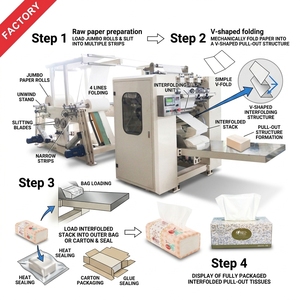
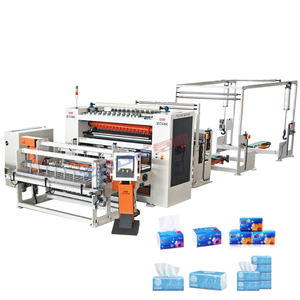
A full turnkey automated facial tissue processing installation comprises four synchronized mechanical modules operating under a unified master Programmable Logic Controller (PLC) architecture:
1. Parent Roll Unwinding & Embossing Unit: Outfitted with pneumatic jumbo roll loading, active belt unwinding with tension transducers, and dynamic edge-alignment sensor systems (EPC). Depending on target market specs, this unit integrates point-to-point, steel-to-rubber, or steel-to-steel embossing rollers. High-end machines utilize micro-embossing with thermo-controlled roll surfaces to optimize tissue bulk and softness without compromising tensile strength.
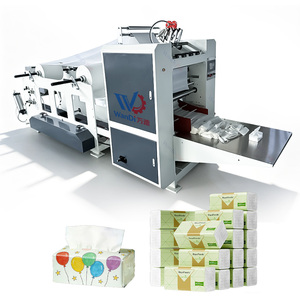
2. Vacuum Interfolding Engine (V-Fold / Z-Fold / W-Fold): The core mechanical engine converts continuous paper webs into interfolded tissue stacks. Utilizing high-capacity roots vacuum blowers connected to dual rotating folding cylinders, the paper web is alternately cut, folded, and interleaved. The precise timing of the vacuum suction release valve dictates fold symmetry and stack consistency.
3. Automated Orbital or Servo Log Saw Cutting: High-speed log saw machines slice continuously fed tissue "logs" into exact customer-defined widths (e.g., 100mm to 210mm). Outfitted with circular alloy steel blades running up to 350 cuts/minute per lane, these systems incorporate automated blade sharpening, dust extraction hoods, and optical trim disposal systems to guarantee burr-free edge cuts within ±0.5mm tolerances.
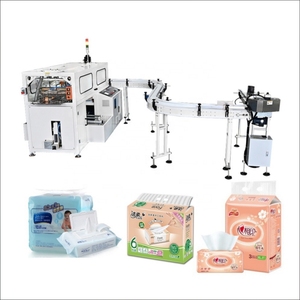
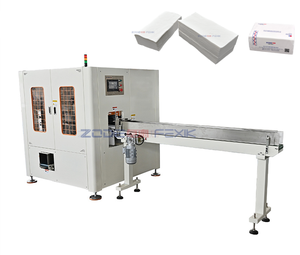
4. Primary & Secondary Automated Packaging: The processed tissue stacks enter automated soft-pack film wrappers or carton box filling systems. Modern automated lines utilize multi-axis motion control to achieve film wrapping speeds up to 120 packs per minute, followed by automatic bundlers or robotic case packers for export cartoning.
Future Procurement Trends in Facial Tissue Manufacturing Equipment (2025–2030)
As retail end-users demand eco-friendly tissue formats, softer textures, and plastic-free packaging, industrial tissue machinery buyers must align their procurement criteria with emerging engineering and market shifts. Sourcing leaders evaluating China tissue machine suppliers should analyze the following key macro procurement trends:
Full Servo & Direct-Drive Kinematics
Elimination of traditional mechanical gearbox transmission chains in favor of multi-axis absolute servo control systems (Siemens, Beckhoff, or Mitsubishi). Direct-drive motors minimize mechanical wear, drastically reduce machine noise below 75 dB, and allow zero-downtime digital changeovers between tissue lengths and sheet counts.
Alternative Fiber & Non-Woven Compatibility
Global tissue mills are rapidly increasing the proportion of non-wood fibers, including bamboo pulp, bagasse, and spunlace cotton non-woven webs. Next-generation machinery requires reinforced folding claws, specialized anti-static webbing, and custom vacuum blade profiles capable of handling high-density or high-elasticity fibers without jamming.
Energy Minimization & Vacuum Optimization
Vacuum blowers traditionally account for up to 35% of a facial tissue line's total electrical consumption. Advanced Chinese machinery now integrates frequency-controlled turboblowers and energy-recovery air flow channels, reducing power consumption by 22–30% per ton of converted tissue.
Future Industry Development Trends: Smart Manufacturing & Industry 4.0
The global tissue manufacturing sector is undergoing rapid digital integration. Sourcing processing machinery requires an evaluation of the equipment's long-term digital architecture and smart manufacturing compatibility:
IoT-Enabled Remote Telemetry & Predictive Maintenance
Modern Chinese tissue machine wholesalers are embedding cloud telemetry modules and OPC-UA communication protocols directly into main control cabinets. This enables real-time monitoring of motor temperatures, bearing vibration frequencies, blade wear indicators, and pneumatic pressure drops. Plant engineers can diagnose thermal anomalies or mechanical misalignments weeks before catastrophic line failure occurs, achieving 98%+ planned uptime operational baselines.
Inline Machine Vision & Quality Inspection
To eliminate manual visual sampling, high-speed lines now incorporate high-definition CCD cameras positioned at the output of the log saw cutter. Automated machine vision algorithms continuously inspect tissue stack profiles for missing interfolds, uneven trim cuts, embossing misregistration, and surface oil contamination, automatically ejecting defective packs at line speed without slowing downstream overwrappers.
Modular Line Architecture & E-Commerce Flexible Packaging
With the explosive growth of online tissue retail, soft-pack bundle sizes vary dynamically—from compact 3-pack travel packs to mega 24-pack home supply bundles. Modern machine design emphasizes modular sub-assemblies. Wholesalers and manufacturers now build plug-and-play bagging, cartoning, and shrink-wrapping modules that connect seamlessly to the base interfolder via Ethernet/IP control networks.
Manufacturer Profile & Engineering Authority: Andina Heavy Tissue Machinery S.A.
When selecting a manufacturing partner in China for tissue converting equipment, verifying real engineering infrastructure, quality control systems, and overseas service frameworks is critical. Operating under international standards, Andina Heavy Tissue Machinery S.A. represents the apex of Chinese high-heavy tissue machinery engineering:
30+ Years Manufacturing History
Established in 1993, Andina Heavy Tissue Machinery S.A. has dedicated over three decades exclusively to tissue converting, paper making, and tissue wrapping machinery innovations.
Global Installation Baseline
Over 1,500 active converting lines deployed across 160+ countries and regions, including North America, Europe, Latin America, the Middle East, and Southeast Asia.
R&D & Quality Certification
ISO9001:2015 certified production processes, CE compliance certification, and holding more than 50 national mechanical design and software algorithm patents.
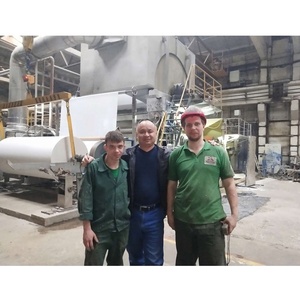
Manufacturing Infrastructure: Spanning three specialized production bases in Shanghai, Foshan, and Chengdu totaling over 10,000 square meters of CNC machining centers, dynamic roll balancing stations, and automated assembly bays. Every machine undergoes a compulsory 72-hour continuous trial run with customer-specified paper stock prior to global export shipping.
Frequently Asked Questions (FAQ) for B2B Equipment Buyers
Detailed technical answers for procurement teams, tissue converting factory owners, and chief engineering officers evaluating Chinese manufacturing machinery:
Which tissue paper product formats can your equipment convert and package?
What is the practical production speed and capacity difference between mechanical vs fully servo-driven facial tissue machines?
How does the machine accommodate variations in paper basis weight (GSM) and fiber tensile strength?
Can packaging formats (soft-pack vs box) be changed on the same production line?
What international safety standards and factory compliance certifications are provided?
What after-sales service, installation, and spare parts support is available overseas?
Accelerate Your Tissue Converting Operations
Connect directly with our senior application engineers to obtain custom line layouts, ROI calculation sheets, and full equipment technical specifications tailored to your production facility.
Get Catalog