Flagship Tissue Converting & Packaging Equipment
Engineered for high-efficiency operations, precise web tension control, and flexible packaging formats.
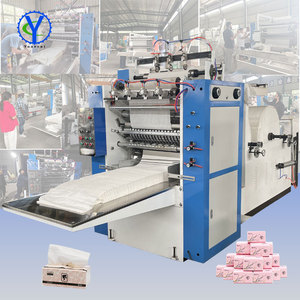
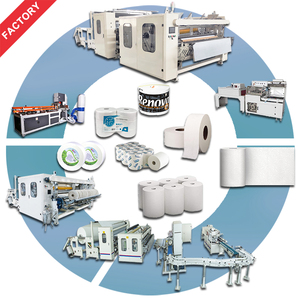
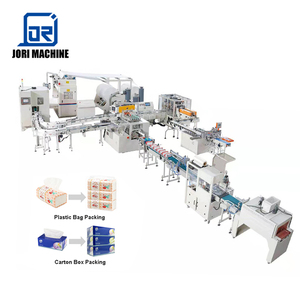
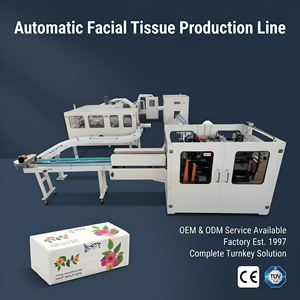
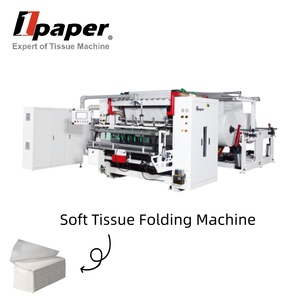
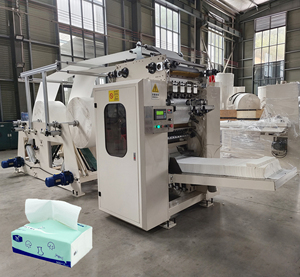
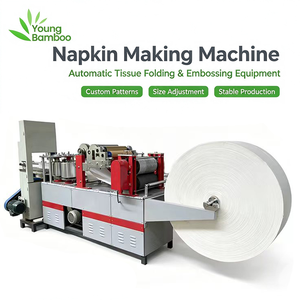
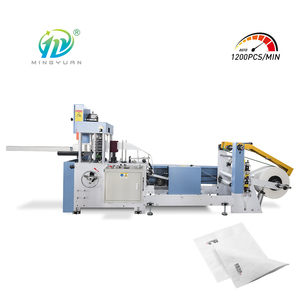
State of the Art: Automatic Facial Tissue Converting Machinery Engineering
The global household paper converting sector has evolved rapidly from mechanical linkage systems toward fully integrated, multi-axis servo motion architectures. Modern automatic facial tissue machines represent the apex of fast-moving consumer goods (FMCG) packaging technology, combining high-speed pneumatic web handling, vacuum-assisted interfolding, dynamic log saw cutting, and zero-defect soft-pack cartoning.
As a premier OEM/ODM manufacturer headquartered in China with production bases across Shanghai, Foshan, and Chengdu, Andina Heavy Tissue Machinery S.A. engineers end-to-end tissue lines engineered to eliminate mechanical bottlenecks, minimize material slitting waste, and maintain structural sheet integrity under continuous 24/7 operating schedules.
1. Closed-Loop Parent Roll Unwinding & Tension Precision
The primary point of failure in high-speed tissue converting is tension variance caused by inconsistent parent roll density, humidity variations, and diameter decay during unwinding. Our automatic facial tissue machinery incorporates continuous pneumatic tension sensors linked directly to Siemens/Beckhoff motion controllers. As the parent roll diameter decreases, servo drives modulate unwinding torque dynamically, allowing smooth acceleration up to line speeds exceeding 200 meters per minute.
2. Advanced Interfolding Kinematics (V-Fold, Z-Fold, W-Fold)
Interfolding requires extreme mechanical symmetry. Whether producing standard V-fold (single interfold) or Z-fold/W-fold pop-up facial tissues, paper web control relies on precision-machined vacuum suction rollers. Helical cutting rollers feature tungsten-carbide treated blades, delivering razor-sharp slitting without fiber fraying. Dual-vacuum channels inside the folding cylinders ensure that alternating sheets overlap with sub-millimeter accuracy, guaranteeing smooth end-user dispensing from box or soft-pack packaging.
3. Dynamic Log Saw Cutting with Automated Blade Management
Once tissue webs are interfolded into continuous logs, they transition to the high-speed log saw cutting unit. Utilizing orbital circular blades operating at up to 200 cuts per minute per lane, our systems employ real-time grinding units. Automatic blade sharpening and thermal expansion compensation preserve square, crush-free edge cuts across multi-ply tissues ranging from 13 to 22 gsm per ply.
Technical Benchmark & Line Specifications Matrix
Comparison of entry-level, medium-scale, and enterprise-grade automatic facial tissue converting configurations.
| Performance Indicator | Modular Starter Line | High-Speed Servo Line | Turnkey Enterprise System |
|---|---|---|---|
| Design Line Speed | 80 – 120 m/min | 150 – 200 m/min | 220 – 250+ m/min |
| Folding Capacity (Sheets/Min) | 1,200 – 2,500 sheets/min | 3,500 – 6,000 sheets/min | 8,000 – 12,000+ sheets/min |
| Web Width Capability | 420mm – 840mm (2-4 Lanes) | 1260mm – 1680mm (6-8 Lanes) | 2100mm – 2940mm (10-14 Lanes) |
| Control Architecture | PLC + Touch HMI | Multi-Axis Motion Servo (EtherCAT) | Full Smart IoT + Cloud Diagnostics |
| Embossing Units | Steel-to-Rubber (Optional) | Steel-to-Steel / Point-to-Point | 3D Micro-Nested Laser Engraved |
| Overall Equipment Effectiveness (OEE) | > 85% | > 92% | > 96.5% |
| Primary Application | Regional Brands / Startups | Commercial Converts & OEM | Multinational Tissue Corporations |
*All technical configurations can be tailored based on raw material substrate (virgin wood pulp, bamboo pulp, recycled fiber, or non-woven cotton) and factory layout requirements.
Strategic Procurement Trends in the Global Tissue Industry (2025–2030)
Procurement directors and factory managers evaluating machinery investments must look beyond initial capital expenditure (CAPEX) to assess Total Cost of Ownership (TCO), energy footprint, and adaptability to changing retail consumption patterns. Key trends dominating global procurement include:
1. Shift from Hard-Box to Flexible Soft-Packs
Retail demand for plastic-film soft-pack facial tissue has surged due to lower shipping weight, reduced packaging costs, and e-commerce logistics compatibility. Procurement strategies favor converting lines capable of seamlessly feeding automatic soft-pack overwrapping machines.
2. Alternative Fiber Compatibility
With fluctuating virgin wood pulp prices and stricter ESG mandates, converting plants are transitioning toward 100% bamboo fiber, bagasse pulp, and non-woven cotton substrates. Machinery must feature specialized slitting geometry and adjustable vacuum pressure to process diverse tensile strengths.
3. Smart Factory IoT Integration
Modern buyers mandate real-time OEE tracking, predictive maintenance diagnostics, and remote cloud troubleshooting. Industry 4.0 connectivity enables remote firmware optimization and early detection of bearing wear before catastrophic downtime occurs.
Facial Tissue Machinery Technology Development Roadmap
The engineering trajectories shaping next-generation automatic facial tissue manufacturing centers around five critical technological innovations:
- Cassette-Based Rapid Format Changeover: Traditional line re-tooling for varied fold lengths required hours of mechanical dismantling. Modern machine designs utilize modular cassette folding heads that can be swapped in under 30 minutes, drastically boosting production flexibility.
- Direct-Drive Servo Integration: Eliminating mechanical gearboxes, main drives, and timing belts reduces power consumption by up to 22% while eliminating oil contamination risks across hygienic tissue products.
- Automated Robotic Case Packing: Integrating Delta and SCARA robotic arms at the end of the line automates bundle collection, carton packing, and palletizing, reducing labor demands from 6 operator positions to a single supervisory operator.
- Eco-Friendly Paper Packaging Options: To comply with plastic-free legislation in the EU and North America, converting machinery is adapted to run heat-sealable paper wrapping films as a direct replacement for polyethylene (PE) or polypropylene (PP).
- Intelligent Vision Quality Inspection: In-line camera systems scan interfolded sheet edges, embossing clarity, and perforation accuracy at maximum speed, automatically ejecting non-conforming packs without slowing down the line.
Enterprise Capabilities & Manufacturing Excellence
Since its founding in 1993, Andina Heavy Tissue Machinery S.A. has grown from a specialized machinery workshop into a global powerhouse in tissue converting technology. Our manufacturing ecosystem is designed to guarantee quality from raw raw metal processing to final field commissioning.
Equipped with multi-axis gantry milling centers and precision lathe systems to produce wallboards, folding rollers, and cutter beds in-house, ensuring mechanical tolerances within ±0.01mm.
Every machine undergoes a continuous 72-hour trial run using customer-specified parent paper stock before disassembly and export packing, ensuring instant factory startup upon delivery.
With operational installations in over 160 countries, our field engineering teams provide overseas installation guidance, operator training, rapid spare parts fulfillment, and lifetime software updates.
Certified under ISO9001 quality management systems with full European CE safety compliance, incorporating safety light curtains, emergency stops, and low-voltage electrical controls.
Frequently Asked Questions for Machinery Procurement
Technical and commercial guidance for tissue converting engineers and buyers.